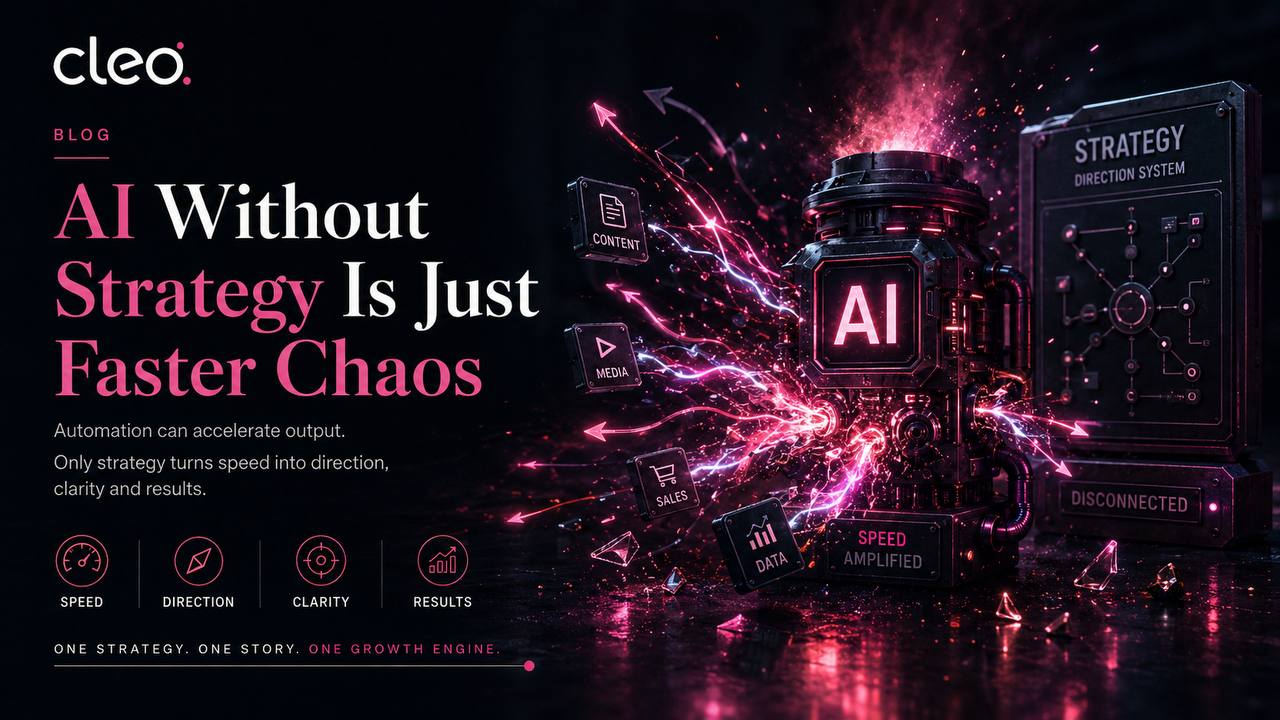
This is the third piece in our series on why campaigns fail to convert. It picks up a point made in the lead article: AI has changed how fast a campaign can move, but it hasn't changed why campaigns fail.
The gap between adoption and value
Nearly every marketing team is using AI in some form now, roughly 88% by most counts. That's not the interesting number. The interesting number is McKinsey's finding that close to 90% of marketing leaders are experimenting with AI, and fewer than one in ten have captured measurable value from it across an entire workflow, start to finish. Most of what's happening is disconnected pilots, a chatbot here, a content tool there, none of it touching the actual structure of how a campaign gets built.
Gartner's most recent CMO survey found something worth sitting with: 70% of CMOs say their internal processes simply aren't mature enough to scale AI properly, even though AI now takes up an average of 15.3% of the marketing budget. Businesses are spending real money on tools their own process isn't built to use well.
The businesses actually seeing a return
BCG and Google's joint research found something specific: the roughly 19% of marketers who've integrated AI deeply into how they actually work, not as a bolt-on tool but as part of the operating process, report 60% greater revenue growth than their peers, and adapt to shifting consumer trends twice as fast. Deloitte found a similar pattern, businesses using generative AI extensively in marketing exceeded their revenue goals by 22% on average, and 41% reported real reductions in content production cost.
The common thread across every credible study on this is the same: AI's return depends entirely on the coherence of what it's added to. Publicis has been explicit about this in their own results, crediting their integrated AI platform with powering every pitch they won this year and driving accelerating growth, but that platform sits inside an already integrated agency model. It's not the AI doing the work alone. It's AI inside a process built to use it properly.
Why this matters for agencies specifically
Gartner's 2025 data included an uncomfortable finding for agencies: 22% of CMOs said generative AI had let them reduce how much they rely on external agencies, and 39% said they planned to cut agency budgets as a result. That's not a reason to fear AI. It's a reason to prove, clearly, that the AI layer you're offering actually moves the number that matters, rather than just producing more content faster.
Where AI genuinely earns its place
There's a specific, well-documented example worth naming: speed to lead. MIT's research on this, based on around 15,000 leads, found the odds of qualifying a lead are 21 times higher when contacted within five minutes rather than thirty. Harvard Business Review's analysis of over a million leads found companies responding within an hour were seven times more likely to qualify that lead than those who waited even slightly longer, and 60 times more likely than those who waited a full day. And 78% of buyers say they end up going with whichever company responded first, not the cheapest, not the best reviewed, the fastest.
Only around 7% of companies actually hit that five minute window. The average B2B response time sits at roughly 47 hours, nearly two working days. That gap costs nothing extra in media spend to close, and it's exactly the kind of problem AI is genuinely built to solve.
This is what our AI team, Foundry, is built around. Not content generation as a novelty, but the specific, measurable gaps where speed and consistency change the outcome: leads answered within minutes instead of two days, personalisation applied at a scale no team could manage manually, budget stretched because less of it is spent redoing work that should have landed correctly the first time. McKinsey's own estimate is that agentic workflows built this way can accelerate campaign execution by ten to fifteen times, some businesses are already reporting exactly that. Those are projections worth treating as exactly that, projections, not guarantees. What's not a projection is the five minute window, and how much revenue sits behind closing it.
What we'd tell you before you buy any AI tool
Ask what process it's being added to before you ask what it can do. AI inside a fragmented, disconnected campaign will make that campaign fail faster and more expensively. AI inside a coherent one, where strategy, creative and media are already talking to each other, is where the 60% revenue growth BCG and Google measured actually comes from.
FAQ
Is AI actually improving marketing results, or just producing more content faster? Both are true, but they're not the same thing. Nearly 90% of marketing leaders are experimenting with AI and fewer than 10% have captured real value from it end to end, according to McKinsey. The businesses seeing genuine revenue growth are the ones who added AI to an already integrated process, not the ones who added more content to a broken one.
What's the single highest-value use of AI in a marketing campaign right now? Speed to lead has the clearest, best-documented case. Leads contacted within five minutes are 21 times more likely to qualify than those left thirty minutes, and only around 7% of companies currently hit that window. Closing it requires no extra media spend, only faster, more consistent response.
Should I be worried AI will replace the need for an agency? The data suggests something more specific: Gartner found 39% of CMOs plan to cut agency budgets because of what generative AI now lets them do in-house. The agencies still winning work are the ones proving their AI layer moves a real number, not the ones treating it as a marketing line on their own website.
Explore how Foundry accelerates campaigns without the guesswork. Visit foundryworks.ai