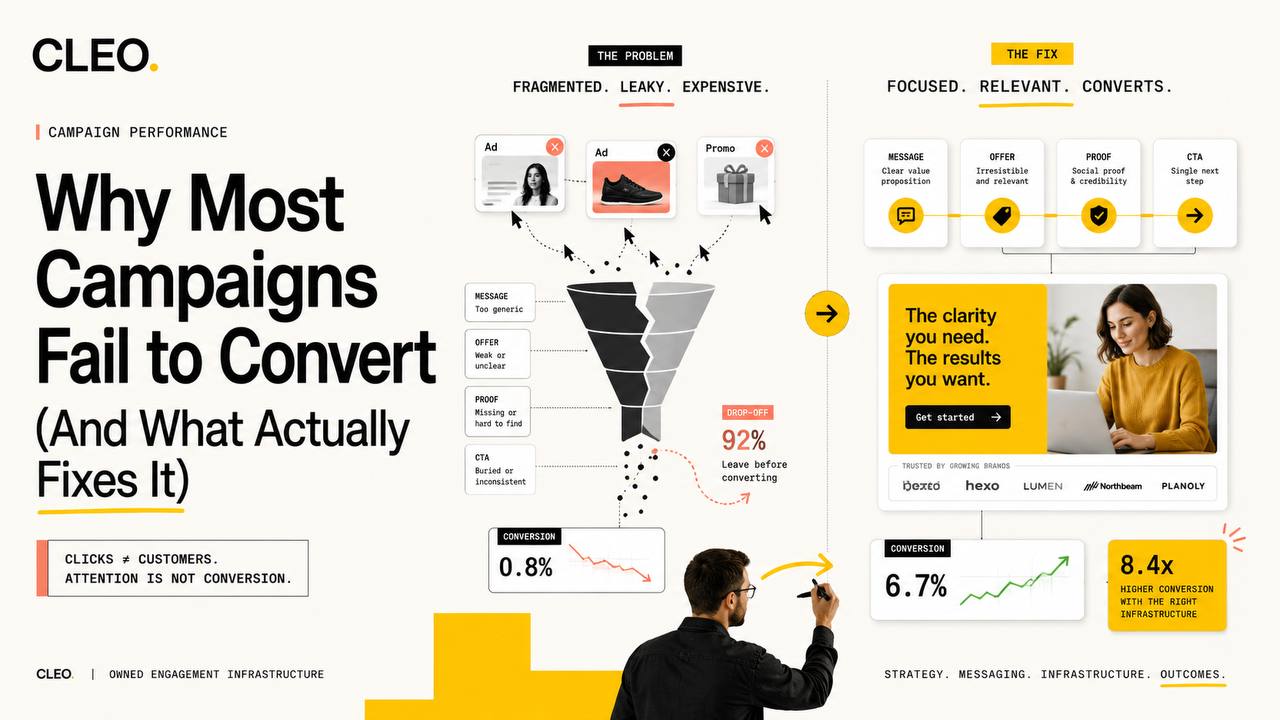
Twenty five years in this industry teaches you one thing above everything else: a campaign rarely fails because of one bad decision. It fails because five good decisions were made in five different rooms, by five different people, none of whom were talking to each other.
The strategist wrote a brief nobody in the studio read properly. The creative team built something beautiful that had nothing to do with what the media buyer was targeting. The media buyer hit their cost per click target while sending traffic to a landing page that didn't say what the ad said. Everybody hit their number. The business got nothing.
That's not a hypothetical. That's most campaigns.
The problem isn't the tactics. It's the seams.
Every individual piece of a modern marketing stack can be excellent and the whole thing can still fail, because the failure happens in the gaps between them, not inside any one of them.
IDC puts a figure on this: businesses that fail to align sales and marketing lose up to 10% of revenue every year, and the total cost of that misalignment across the US economy runs to roughly a trillion dollars annually. Aberdeen's research found aligned organisations grow 31.6% year over year, while poorly aligned ones see revenue decline by 6.7%. That's not a rounding error. That's the difference between a growing business and a shrinking one, and it comes down to whether the people running the campaign are actually working from the same brief.
The buyer's side of this has got harder too. Gartner puts the average B2B buying group at six to ten people, each arriving with information they gathered independently, and 77% of B2B buyers now describe their most recent purchase as complex or difficult. Around 80% of the buying journey happens before anyone speaks to a salesperson. A fragmented campaign, built by disconnected vendors chasing disconnected KPIs, was never built to survive contact with a buying committee that complicated. A campaign built as one coherent thing, strategy through to activation, has a fighting chance.
What fragmentation actually costs you
We see this pattern constantly with businesses that have stitched together a freelance creative, a media buying agency and a martech vendor, none of whom have ever been in the same meeting. Each one is optimising for their own scoreboard. The freelancer wants work that looks good in a portfolio. The media buyer wants a low cost per click. The martech vendor wants tool adoption. None of them are being paid to care whether the business converts a customer, because none of them own that outcome.
The numbers back up what that feels like from the inside. Businesses running fragmented marketing operations are estimated to spend around 20% more on media buying than integrated peers, for no better result. Growth stage companies juggling sixteen or more disconnected tools report a return on investment they genuinely cannot explain, close to 90% of them say so. Integrated campaigns, where strategy, creative and media are built by one accountable team working from shared data, are cited as delivering up to 30% higher return than the siloed alternative.
One thing we've measured directly in our own work: cost per qualified lead can fall by 40% in a single quarter simply by removing the handoffs. Same budget. Same channels. The only change is that the person writing the content, the person building the campaign, and the person buying the media are now the same team, working from the same brief, seeing the same data.
The four places a campaign actually breaks
After enough campaigns, you learn to check the same four places first, in this order.
The brief never survived the handoff. What the strategist meant and what the creative team built are not the same thing, and nobody caught it before it went live.
The creative was never given the credit it deserves. More on this below, because it's the single biggest lever most businesses ignore.
The media buy and the landing experience are telling two different stories. The ad promises one thing, the click lands somewhere that promises something else, and the person leaves confused rather than converted.
Nobody's actually looking at the whole funnel. Everyone's watching their own metric. Nobody's watching whether a lead becomes a customer.
Why creative is the lever most businesses under-fund
This is the part of the industry that gets it most wrong, consistently, at scale. NCSolutions analysed 455 CPG campaigns across digital and television and found creative quality drives 49% of incremental sales, more than targeting, reach and recency combined. Kantar and WARC found the most creatively effective ads generate more than four times the profit of weak ones, and that holds true whether you're building a brand or chasing a short term sale.
Here's the gap. When Advertiser Perceptions asked marketers and agencies to estimate creative's share of that result, they put it at roughly half its real value, around 21%. Most businesses are investing in creative as though it's a supporting player, when the evidence says it's carrying the show.
We built our approach around correcting exactly that imbalance. There's a full breakdown of why in the next piece in this series.
Where AI actually helps, and where it doesn't
AI has changed how fast a campaign can move. It hasn't changed why campaigns fail. McKinsey's research is blunt about this: nearly 90% of marketing leaders are experimenting with AI, and fewer than one in ten have captured any value from it end to end. The businesses seeing real return, BCG and Google found roughly 60% greater revenue growth among the minority who've integrated AI properly into how they work, are the ones who built it into an already coherent process. Everyone else is just moving faster in the wrong direction.
This is where our AI team, Foundry, sits inside the wider approach. Not as a separate product bolted onto the side, but as the layer that makes an already integrated campaign move quicker: content produced faster without losing brand voice, leads responded to in minutes instead of the industry average of 47 hours, budget stretched further because less of it is spent re-doing work that should have been right the first time. AI accelerates a good process. It does nothing for a broken one.
The honest engagement layer
There's one more piece worth naming here, because it's structural rather than tactical. A discount code gets you a form fill. It doesn't get you a customer who actually wants to be there. Zeno's research found consumers are four to six times more likely to buy from, trust and defend a brand with genuine purpose behind it, and WARC's 2025 data shows 78% of consumers feel a deeper connection to brands that communicate their mission honestly. The caveat matters as much as the finding: that only works when the purpose is real. Consumers spot the difference between a brand doing something and a brand saying something, and superficial "purpose" campaigns erode trust faster than having no purpose message at all.
This is the thinking behind Zenko, our purpose engine. Instead of a discount tripwire, Zenko ties the reward to something someone actually did, a completed action that funds something real. In our own campaign data, that distinction shows up as engagement improving by over 200% and cost per lead falling by more than 60% against prior benchmarks. We treat that as our own figure, not an independently audited industry statistic, but the mechanism lines up with the wider research: honest value exchange brings in people who want to be there, not people chasing whichever offer is loudest that week.
What actually fixes it
Not a bigger budget. Not a new platform. The fix is putting strategy, creative, media and measurement back under one accountable roof, so the person who wrote the brief, the person who built the creative, and the person who bought the media are answering to the same number: did this convert.
We've built the rest of this series around the specific pieces of that fix. How the fragmentation actually costs you money. Why creative deserves more credit and more budget than it gets. Where AI genuinely helps once the process underneath it is sound. What separates purpose that converts from purpose that gets ignored. And the weekly discipline that keeps all of it honest once the campaign is live.
FAQ
Why do campaigns with a good creative idea still fail to convert? Usually because the idea never survived contact with the rest of the funnel. The media buy targets the wrong audience for that message, or the landing page tells a different story than the ad, or the lead that comes in gets no response for two days. A good idea, executed by disconnected teams, produces a disconnected result.
Is AI actually making campaigns convert better, or just move faster? Both, but only for the businesses that had a coherent process before they added AI. McKinsey found fewer than 10% of marketing leaders have captured measurable value from AI end to end, while BCG and Google found the minority who've integrated it properly into their workflow see roughly 60% greater revenue growth. AI amplifies whatever process it's added to, good or broken.
How much of a campaign's result actually comes from the creative, versus the targeting or the media spend? NCSolutions' analysis of 455 CPG campaigns found creative accounts for 49% of the sales effect, more than targeting, reach and recency combined. Most businesses invest in it as though it's worth about half that.
Does purpose-led marketing actually convert better, or is that just a nice story? The consumer research is consistent: Zeno found people are four to six times more likely to buy from and defend a brand with genuine purpose. The condition is authenticity. Superficial purpose messaging, sometimes called purpose-washing, does measurable damage to trust rather than building it.
Explore how Cleo builds campaigns strategy through to activation, with Zenko as the purpose engine and Foundry as the AI acceleration layer. Visit /how-we-work/