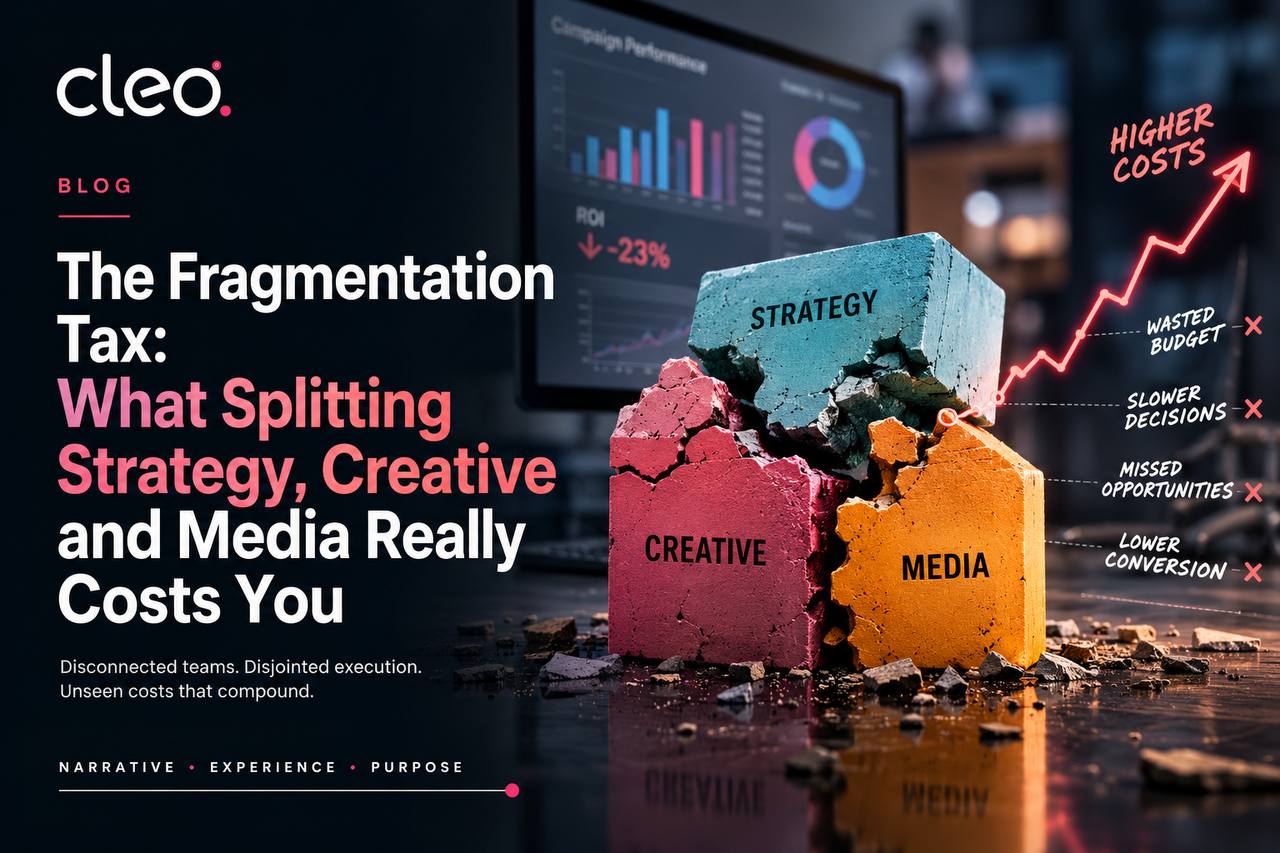
This is a companion piece to Why Most Campaigns Fail to Convert. That piece made the case that campaigns fail in the gaps between vendors, not inside any single vendor's work. This one puts a number on what those gaps actually cost.
The stack that looks efficient on paper
Most growing businesses build their marketing function the same way, one piece at a time, as the need appears. A freelance designer for creative. A media buying agency for paid spend. A martech or AI vendor for automation. Each hire looks sensible in isolation. Each one is cheaper, on its own invoice, than a single integrated team.
Add them up and the picture changes. Growth stage companies typically run sixteen or more disconnected marketing tools. Businesses with fragmented operations are estimated to spend around 20% more on media buying than integrated competitors, for no corresponding improvement in result. Nearly 90% of companies running eleven to twenty five separate tools say they cannot clearly explain their marketing return on investment, against 62% of companies running a smaller, tighter stack.
None of that shows up as a line item called "fragmentation cost." It shows up as a media bill that's slightly too high, a creative team that's slightly out of step with the brief, and a leadership team that's slightly unsure what any of it is actually producing.
Why each vendor optimising for themselves adds up to nobody winning
Here's the mechanism, plainly. A freelance creative gets paid whether the ad converts or not, so they optimise for something they can control, how the work looks. A media buyer gets measured on cost per click or cost per lead, so they optimise for that number, regardless of whether the lead that number produced ever becomes a customer. A martech vendor gets measured on whether you keep paying the subscription, so they optimise for adoption, not outcome.
Every one of them can hit their target. The business can still get nothing, because nobody in that chain is being paid to care about the number that actually matters: did this become revenue.
What we've measured directly
We've watched this play out consistently enough to know the fix isn't complicated, it's structural. Aligning content topics with active paid campaigns, syncing landing page messaging with the ad copy that drove the click, and putting strategy, creative and media under one accountable team rather than three separate invoices, we've seen cost per qualified lead fall by 40% in a single quarter. Same spend. Same channels. The only change was removing the handoffs.
Integrated campaigns, where the full funnel is built and measured by one team, are cited across the industry as delivering up to 30% higher return than the fragmented alternative. That's not a marginal efficiency gain. That's the difference between a campaign that pays for itself and one that quietly doesn't.
The decision that actually matters
There's a reasonable question underneath all of this: when does it make sense to stay fragmented, and when does it clearly not?
If you're running a small number of assets a quarter, and you have someone in-house genuinely coordinating the handoffs between your freelancers and your media buyer, a modular setup can work. The moment you're running more than around fifty assets a quarter, or you're one of the businesses managing sixteen plus disconnected tools with nobody able to explain the ROI, the fragmentation tax has almost certainly outgrown whatever you saved by keeping the pieces separate.
Where Cleo fits
We built Cleo around removing that tax rather than managing around it. Strategy, full-service creative and media activation sit under one team, working from one brief and one set of data, so the person building the creative and the person buying the media are answering to the same conversion number rather than three different scoreboards. Zenko sits inside that as the engagement layer, and Foundry sits inside it as the AI acceleration layer, but the structural point comes first: nothing downstream fixes a campaign that was fragmented from the brief onward.
FAQ
Isn't hiring separate specialists cheaper than an integrated team? Often cheaper on the individual invoice, more expensive in total. Fragmented operations are estimated to spend around 20% more on media buying alone, before accounting for the wasted creative and the leads that never convert because nobody owned the whole funnel.
How do I know if my marketing stack has become too fragmented? Two signals worth checking. Can everyone involved clearly explain what your marketing spend actually returned last quarter, in revenue terms, not clicks or impressions. And has anyone in the chain, creative, media or martech, ever sat in a room together and looked at the same performance data. If the answer to either is no, you're likely paying the fragmentation tax already.
What's the fastest fix if I can't overhaul the whole stack at once? Start by aligning the two pieces most likely to be disconnected right now: your landing page messaging against your live ad copy, and your content calendar against your active paid campaigns. That single alignment is where we've seen the fastest, most measurable improvement in cost per qualified lead.
Explore how Cleo removes the handoffs between strategy, creative and media. Visit /how-we-work/